Public Lands Triangle
Public lands need your help. Every trail, forest, watershed, and open space that belongs to the public exists only because people keep protecting, maintaining, and understanding it. Far too often, we see these places only on vacation and never think about why we have them. It's easy to assume the trail will magically be there next spring like it grew there overnight, or that the land will stay public because it always has been. Behind every accessible, healthy, protected piece of public land is a surprising amount of unpaid, under-caffeinated human effort, and that effort comes in three kinds: advocacy, stewardship, and education.
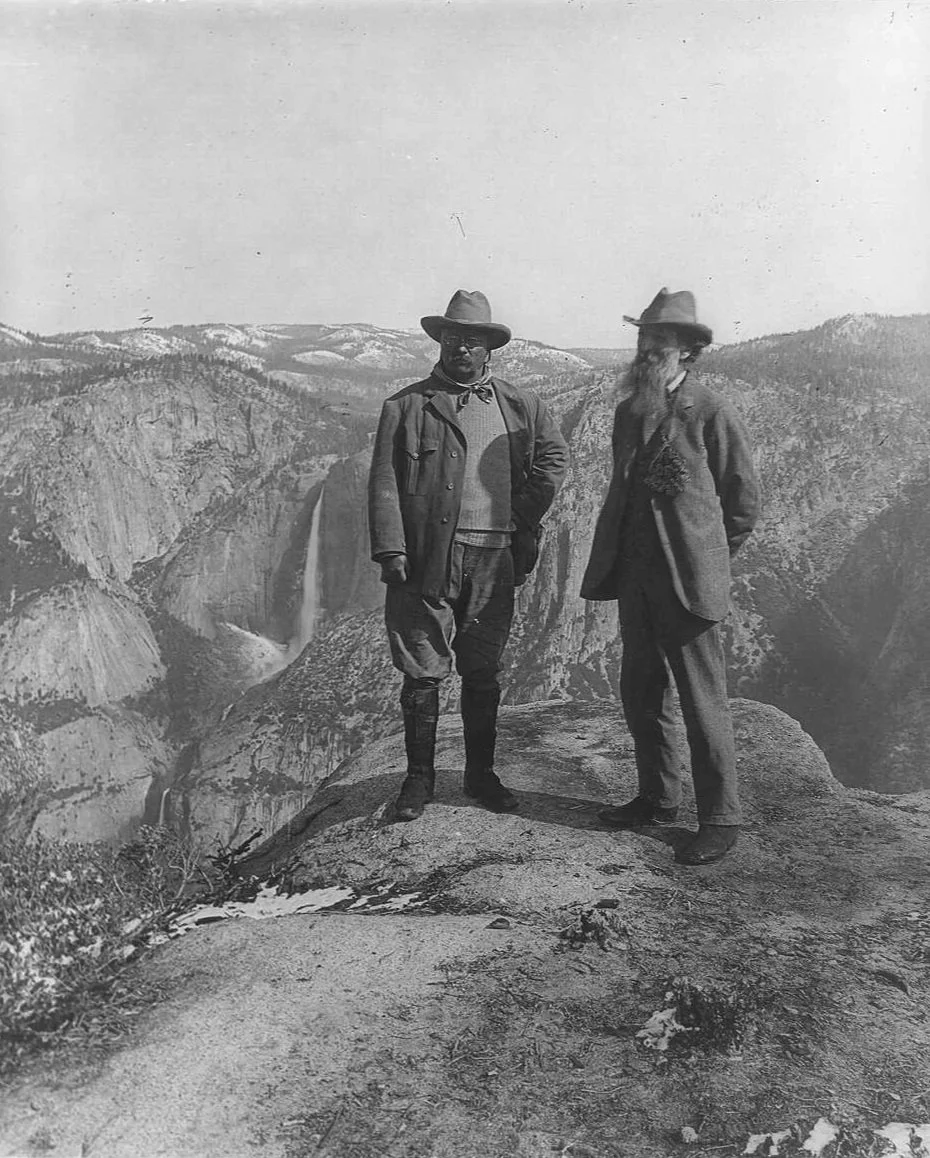
Roosevelt with Muir in Yosemite National Park
Advocacy is the work of protection and resourcing, otherwise known as "yelling at the right people in the right rooms." It means standing up when public land is threatened with sale, privatization, or extraction, and it means securing the funding, through grants, donations, or public dollars, that allows these places to be managed at all instead of just vibes and good intentions. Advocacy is political and financial by nature. It happens in courtrooms, legislatures, and boardrooms as much as it happens outdoors. Without it, public land has no defense against the economic and political pressures constantly circling it like it's a foreclosure sale.
A perfect example of advocacy happened in 1903 when Theodore Roosevelt ditched his entourage to go camping with John Muir, where they discussed the future of Yosemite National Park. A few years later, Yosemite Valley was transferred from the state of California to the federal government. The advocacy worked.
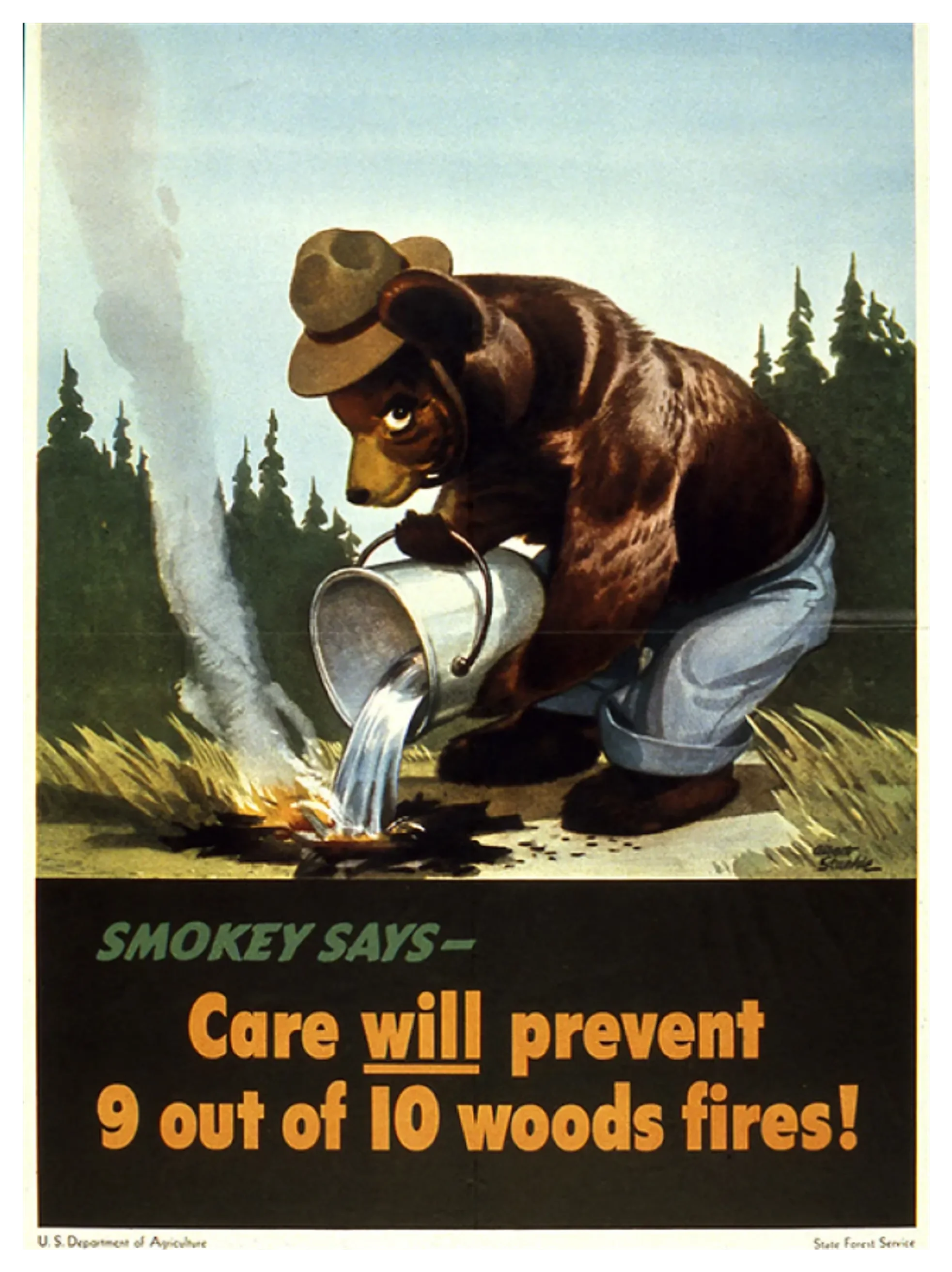
1944 First Smokey Bear poster
Stewardship means rolling up your sleeves and getting dirty. It's the physical, hands-on labor, the part where someone actually shows up with a shovel to dig a latrine. It's building and maintaining trails, removing invasive species, restoring eroded land, and doing the maintenance that keeps a landscape usable and healthy, even something as simple as picking up a dropped wrapper in a park. Stewardship is the most visible, tangible expression of commitment to a place. It takes sustained labor, often from volunteers giving up their time off or from underappreciated government workers, and the work never truly finishes.
During the height of the Great Depression, the government formed the Civilian Conservation Corps to give workers jobs and support their families back home. Young men were sent out throughout the country to build parks; it is hard to visit a state or national park from the Great Depression era and not see the legacy of the CCC. This is putting boots on the ground and funding the creation and maintenance of parks, and we still benefit from it today.
Then there's education. Some of that is Leave No Trace: pack out your trash, stay on the trail, don't carve your initials into anything. But it's also knowing what you're looking at. Which plants belong there and which ones don't. Why the water flows where it does. How the rocks you are hiking on formed. Once you know a little about a place, a hike stops being a long walk to a nice view. You start noticing things, like a campsite getting chewed up or a lake that doesn't look the way it did last year. The people who notice are usually the ones who end up doing something about it.
A great example is Smokey Bear. In 1944, the government produced a set of ads starring him. Smokey told people to be careful with fire when camping and to put out their fires before leaving a campground or going to bed. This educational campaign had a huge impact on Americans.
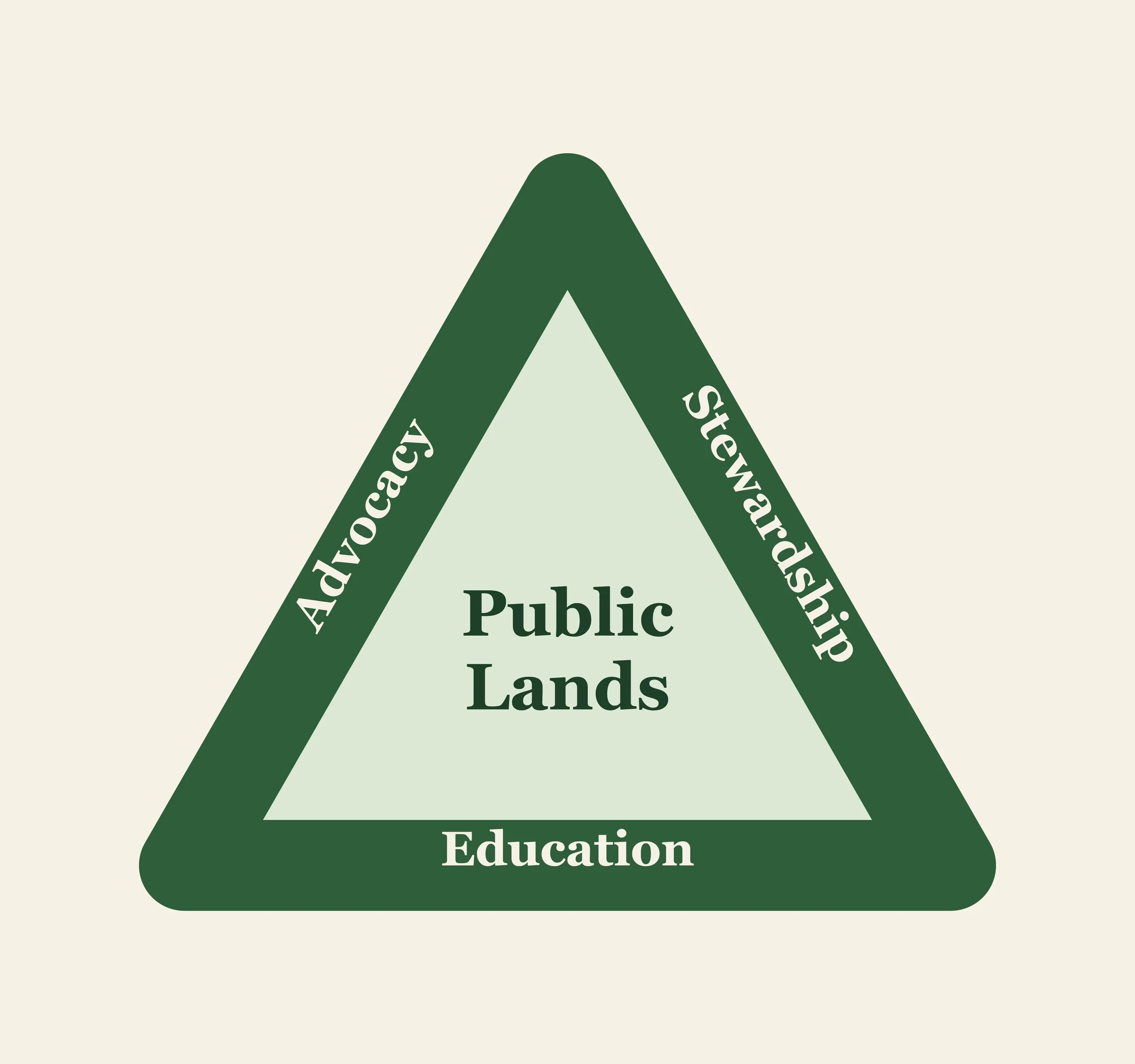
These three kinds of work cannot stand on their own. They form a triangle, and like any triangle, each side depends on the strength of the other two to hold its shape. Most people know a triangle is a strong shape. Unlike a square, it can't collapse or rack out of shape unless one side fails. Without education, no one understands the land enough to advocate for it or know how best to steward it. Without advocacy, there's no funding or protection to make stewardship possible. Without stewardship, the land degrades until it's easy to dismiss as not worth protecting at all, collapsing the very foundation advocacy and education were built on. If any one side goes missing, or simply isn't strong enough to bear its share of the load, the whole structure buckles, and nobody gets to enjoy the space. None of the three is more important than the others. The triangle only holds because all three do their share.
Nowhere is this triangle more visible right now than in the Boundary Waters Canoe Area. Advocacy there means fighting proposed copper-sulfide mining upstream of one of the country's most pristine watersheds. This fight got a lot harder this year when Congress lifted the federal mining ban protecting the area. Stewardship there means the ongoing work of maintaining hiking and portage trails and backcountry campsites across more than a million acres of wilderness, so paddlers can still move lake to lake without hauling their gear through what amounts to a swamp obstacle course. Education there means teaching every visitor Leave No Trace principles before they ever dip a paddle in the water, along with an understanding of the boreal forest ecosystem, the granite bedrock shaped by glaciers, and the watershed hydrology that makes the Boundary Waters what it is, and makes it so vulnerable to whatever bad idea shows up upstream. Remove any one of these and the others collapse.
Public lands survive when all three sides of this triangle carry their share of the weight. If you care about these places, the work isn't choosing which side to stand on. It's about participating. Educate others on what makes our public lands great, advocate to keep them public, open, and unpolluted, and take stewardship over the lands to keep them in good shape.